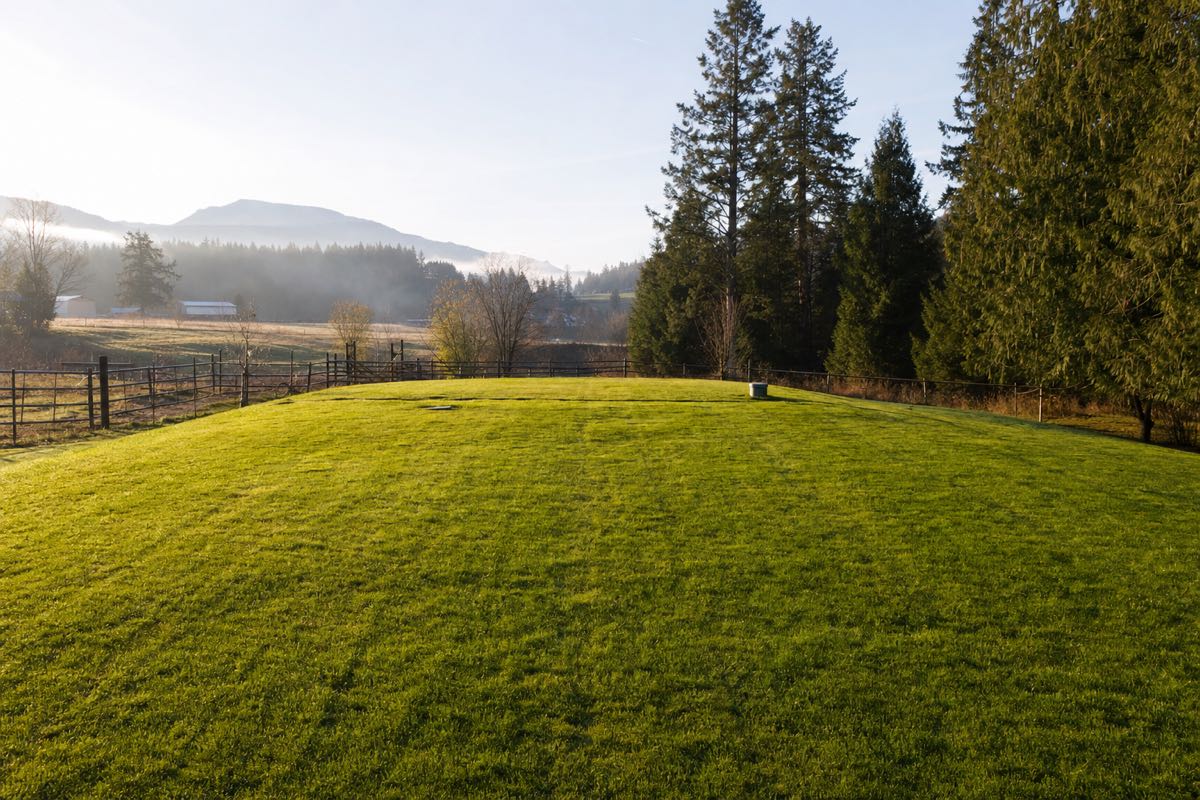
What does the drain field actually do?
It is where treatment happens, using unsaturated soil and the air in it. Everything before the drain field is just plumbing. The field is where treatment happens: a network of perforated pipes laid in gravel or chambers that spreads clarified effluent over a bed of unsaturated soil, where soil microbes finish the job before the water rejoins the groundwater. The critical ingredient is that word unsaturated. Soil can only treat effluent if there is air in it, which is why the field needs vertical separation between the pipes and the seasonal high water table.
That is also why the Fraser Valley is hard country for drain fields. On Sumas Prairie, Matsqui Prairie, Glen Valley and the low ground along the Fraser, winter groundwater rises to within centimetres of the surface. Fields that would live easy lives on a gravelly bench in the Interior spend every valley winter with their margin of safety squeezed thin. When a field here is also fed solids by a neglected tank, failure comes early.
Is it really the field, or something cheaper?
Often something cheaper, and the difference is measured in tens of thousands of dollars. The most important thing we do on a "my field is done" call is check whether it is actually the field. A surprising fraction of the time it is not, and the difference is measured in tens of thousands of dollars:
- A tilted or clogged distribution box starves most of the field and drowns one lateral. Fix the box, and a "failing" field comes back.
- A crushed or root-blocked lateral shows as localized ponding, not systemic failure.
- A full tank or failed pump mimics field failure perfectly: backups, high levels, misery. Cheap fix.
- Surface water problems: roof drains, sump discharge or field drainage directed over the bed can drown a healthy field from above. Redirect the water, and the field recovers.
- Genuine biological clogging: decades of biomat growth or years of solids carryover have sealed the infiltrative surface. This is the real thing, and it does not reverse.
Diagnosis uses the tank's story (levels, baffle condition, pumping history), probing and test pits at the field, water loading, and where useful, locating equipment. You get the findings and the honest verdict before any big number is spoken.
What the repair and replacement options cost
| Work | Indicative Fraser Valley cost | When it applies |
|---|---|---|
| Distribution box repair or replacement | Several hundred to a few thousand | Tilted or clogged D-box starving most of the field |
| Single lateral repair | Hundreds to a few thousand | Crushed or root-blocked run, localized ponding |
| Surface water correction | Varies with the yard | Roof, sump or yard drainage feeding the bed |
| Conventional in-ground field replacement | $15,000 to $30,000 | Good soils, space for a reserve area |
| Sand mound replacement | $55,000 to $65,000 | Valley-floor lots with a high seasonal water table |
Indicative market ranges for the central Fraser Valley as of August 2026, not quotes. Sand mound figures follow published Fraser Valley pricing from a Langley installer and a 2026 Fraser Valley land development guide. The gap between the top and bottom rows is the whole argument for early diagnosis and for pumping on schedule.
What happens when replacement really is the answer?
A five-step regulated process: site and soil evaluation, design, filing with Fraser Health, construction, then certification and a maintenance plan. Replacing a field in BC is regulated work under the Sewerage System Regulation, and Fraser Health charges a $200 filing fee for the submission. The process runs like this:
- Site and soil evaluation. Test pits establish soil type, percolation behaviour and, critically for the valley floor, the seasonal high water table. Setbacks to wells, watercourses and property lines are mapped.
- Design. An Authorized Person (a Registered Onsite Wastewater Practitioner or a professional engineer) designs a system matched to the soils and the home's daily flow: a conventional Type 1 field where conditions allow, or a Type 2 or Type 3 treatment train with a sand mound or pressurized distribution where they do not.
- Filing with Fraser Health. The design is filed with the health authority before construction. No filing, no legal system, and unfiled work haunts property sales.
- Construction. Excavation, imported sand and drain rock where specified, laterals, distribution, pump and controls as designed, with the old field decommissioned properly.
- Certification and maintenance plan. On completion you receive the letter of certification and a maintenance plan. Follow the plan; on treatment systems it is what keeps the warranty and the performance real.
On the flats, expect the design conversation to involve mounds: raising the infiltrative surface in imported sand is the standard way to buy vertical separation from high groundwater. Mounds change the look of a yard and the cost of a job, but they are what makes septic possible at all on much of the valley floor, and a properly built one is a quiet, reliable neighbour for decades.
How do you get decades out of a new field?
Pump the tank on schedule, keep the outlet hardware intact, and keep traffic, roots and surface water off the bed. A replacement field's lifespan is written by its owner's habits. The field never sees solids if the tank is pumped on schedule and the outlet hardware is intact, so those two items alone are most of the battle. Beyond that: keep vehicles, livestock and structures off the bed, keep thirsty trees back, spread water use through the week, and keep roof and surface drainage pointed elsewhere. Every one of these is free, and together they are the difference between a field that lasts 30 years and one that comes back to this page in 12.
What should you do if the field is struggling right now?
Cut water use today, do not trench or jet anything before diagnosis, and start the assessment while it is still summer. Cut water use hard: it is the one lever you control today, and on a marginal field it visibly helps. Do not trench, jet or "aerate" anything before diagnosis, and be wary of additives sold as field restorers. Then call. Early-stage problems have more options and better prices than emergencies, and if you are heading toward replacement, starting the evaluation and filing process early means the work happens on your schedule, in decent weather, rather than in a December crisis.
Frequently Asked Questions
How do I know if my drain field is failing?
The classic signs are wet or spongy ground over the field, sewage odour outdoors, effluent surfacing or pooling, unusually lush green grass in stripes or patches over the laterals, and slow drains or backups that get worse in wet weather. Fields that struggle in winter but recover in summer are in early failure; fields that pond year-round are done.
How much does drain field replacement cost in the Fraser Valley?
A conventional in-ground field replacement in this region typically runs roughly $15,000 to $30,000. Where the seasonal water table forces a sand mound, which is the usual answer on valley-floor lots, published Fraser Valley pricing puts complete sand mound systems at $55,000 to $65,000, and Type 2 or Type 3 treatment adds to that. Site assessment is what turns those ranges into a real number for your property.
Can a failed drain field be fixed without full replacement?
Sometimes. A field failing because of a tilted distribution box, a crushed lateral, root intrusion or years of solids carryover from a missing baffle can respond to targeted repair of the actual cause, and resting a field can partially restore capacity where a second field or spare area exists. Genuine biological clogging of the infiltrative surface at end of life, however, is not reversible, and honest assessment tells you which case you have.
How long does a drain field last?
A well-built, well-maintained conventional field commonly serves 20 to 30 years. Neglected pumping, garburators, grease, vehicles on the field and high groundwater all shorten that, sometimes drastically. The single biggest life-extender is keeping solids in the tank through regular pumping.
Who is allowed to replace a drain field in BC?
Replacement of a drain field is regulated work under the BC Sewerage System Regulation. It must be designed and carried out under an Authorized Person, meaning a Registered Onsite Wastewater Practitioner or a professional engineer, with a filing to Fraser Health including the site evaluation and design, and a letter of certification when the work is complete. Keep every one of those documents; the paper trail matters when you sell.
Will the new field go in the same place as the old one?
Often not. The old footprint is clogged soil, so designs typically use a reserve area if the lot has one. On tight or wet lots, the answer may be a raised sand mound, a smaller footprint made possible by higher treatment, or in rare cases advanced solutions. This is exactly what the site and soil evaluation determines.